
Books and Publications
Dr. Conrad B. Quintyn's scholarly works explore the intricate intersections of biotechnology, genetics, and human biology. His publications provide a rigorous examination of scientific advancement and its profound implications for society, forensic anthropology, and the future of human morphology.

Biotechnology: Scientific Advancement Versus Public Safety
In this book, Dr Quintyn considers whether genetic engineering will exacerbate social injustices and/or lead to public safety issues. As designer babies mature, will they feel a sense of superiority or pass on mutations that negatively affect future generations? Should we ignore the risk of zoonotic (animal) diseases because they offer potential benefits for reducing organ shortages? Scientific advancement, if not guided responsibly and with public input, can be detrimental to public safety. This book is unique as it encompasses many biotechnologies within the definition of biotechnology. It gives a balanced view of biotechnology: its promise as evidenced in repairing mutations (i.e., genetic editing) and its dangers evidenced in creating (unintentionally) dangerous microbes or unregulated germline editing and cloning. Additionally, this book includes animals in biotechnological research because the success, advances, techniques, and science of genetic engineering could not have occurred without using animals (and microorganisms, insects, plants) as model organisms. A comprehensive description of the CRISPR system in bacteria and the exploitation of this knowledge in creating the CRISPR/Cas9 technology is also incorporated in this read. The author's overall goal is to discuss other biotechnology that is being used to improve and put at risk the health, environment, and safety of humans, giving the book a competitive edge. Furthermore, the book provides a provocative side in challenging scientists to consider the current belief governing research and development, which is that scientific advancement and public safety create a false dichotomy. Contents: Preface About the Author Acknowledgments List of Tables Defining Bioengineering: The New Eugenics? Genetic Engineering in the Twenty-First Century: Genetically Modified Organisms Cloning and In Vitro Fertilization Designer or Selected Babies: Self-Controlled Reproduction The 'New World': Discovering the CRISPR System Genome Editing: Rewriting the Fundamental Code of Life Crossing the Rubicon: Therapy versus Elective Enhancement Playing God: Synthetic Biology and the Attempt to Control the Machinery of Life Bioengineering and the Emergence of Dual Use The Murky Waters of Regulation in the Age of Genetic Engineering Benefits and Risks: The Eternal Struggle Making New Mistakes? Bionanotechnology and Nanomedicine Unintended Consequences The Impatience with Natural Selection Transhumanists, Homo evolutis, and Hubris Addendum COVID-19 Glossary Index Readership: Students, professionals: biomedical scientists, social scientists, ethicists, health care providers, policymakers, regulators, research funders, faith healers, industry representatives, patients and their families, people with disabilities, and members of the general public.

The Existence or Non-existence of Race?: Forensic Anthropology, Population Admixture, and the Future of Racial Classification in the U.S.
In this book, Conrad Quintyn details the two intransigent sides of the race issue in biological anthropology and human biology in order to propose a common-sense compromise. This compromise is interesting because it does not derive from academic armchair philosophy. It takes into account practical issues in the social environment. This book is significant to the field, at this time, because it addresses the following issues, which form the basis for discussing the future of racial classification in America: 1) There is a high frequency of admixture in U.S. population caused by the steady flow of immigrants over the years, resulting in multiracial populations. Hundreds of thousands of these multiracial Americans are demanding visibility, acceptance—and in many cases an identity that is separate from “black” or “white;” 2) Officials in federal and state agencies as well as black and Hispanic political activists worry that allowing people to choose more than one race, or eliminating race altogether, would impact civil rights compliance and educational accountability for students by race and ethnicity; distribution of federal aid to minorities; and minority districting in congressional elections. It might also erode black or Hispanic solidarity and confuse law enforcement, since the FBI, state, and local police depend on race for much of their day-to-day work; and 3) Population admixture has increased the difficulty in determining race using the skull, which has implications for human identification in forensic science.
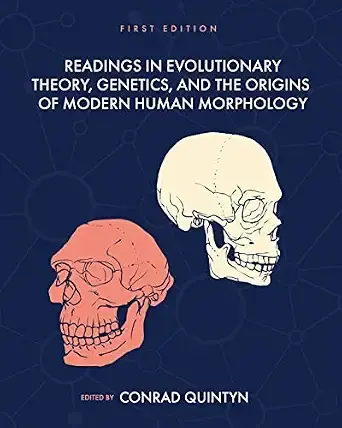
Readings in Evolutionary Theory, Genetics, and the Origins of Modern Human Morphology
In this book, Conrad Quintyn details the two intransigent sides of the race issue in biological anthropology and human biology in order to propose a common-sense compromise. This compromise is interesting because it does not derive from academic armchair philosophy. It takes into account practical issues in the social environment. This book is significant to the field, at this time, because it addresses the following issues, which form the basis for discussing the future of racial classification in America: 1) There is a high frequency of admixture in U.S. population caused by the steady flow of immigrants over the years, resulting in multiracial populations. Hundreds of thousands of these multiracial Americans are demanding visibility, acceptance—and in many cases an identity that is separate from “black” or “white;” 2) Officials in federal and state agencies as well as black and Hispanic political activists worry that allowing people to choose more than one race, or eliminating race altogether, would impact civil rights compliance and educational accountability for students by race and ethnicity; distribution of federal aid to minorities; and minority districting in congressional elections. It might also erode black or Hispanic solidarity and confuse law enforcement, since the FBI, state, and local police depend on race for much of their day-to-day work; and 3) Population admixture has increased the difficulty in determining race using the skull, which has implications for human identification in forensic science.